
Diagnostic Tips
Reading a Voltage Drop the Fast Way
A voltage drop test finds high resistance connections that a simple continuity or resistance check will miss, because it tests the circuit while current is actually flowing under load, which is the only condition that matches how the vehicle is actually failing.
Why Resistance Checks Fall Short
A connection can measure perfectly fine with an ohmmeter and still fail once real current runs through it. Corrosion, a loose crimp, or a partially broken strand inside a wire often only shows up as resistance once the circuit is under load. That is exactly why a car can crank fine on the lift with a meter clipped to the battery, and then intermittently fail to start in the customer's driveway.
How to Run the Test
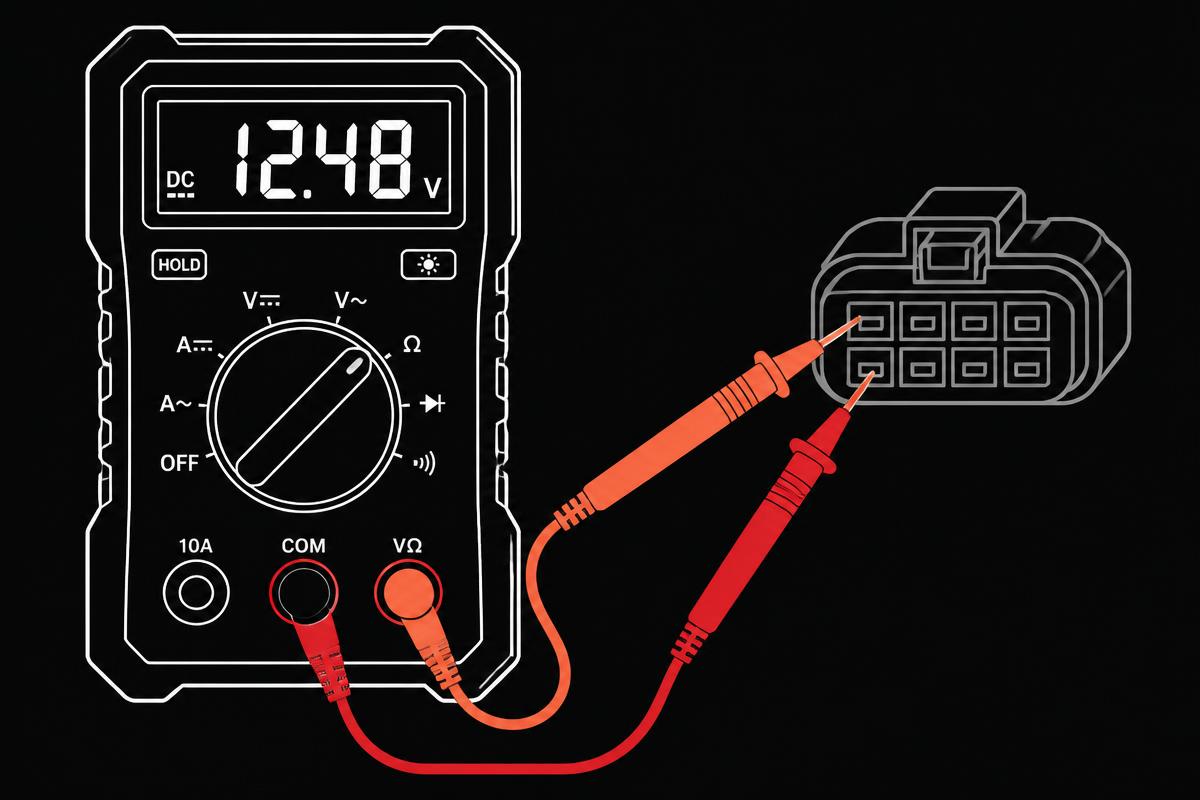
- Set your meter to DC volts, not ohms.
- Place the red lead on the source side of the connection you are testing and the black lead on the load side, keeping the circuit closed so current is flowing.
- Activate the circuit. For a starting circuit, that means cranking the engine while a second person holds the leads in place, or using a remote starter switch.
- Read the voltage shown on the meter. That number is the voltage being lost across that specific connection.
What the Numbers Mean
A clean, healthy connection in a high current circuit like a battery cable or starter connection should show well under half a volt of drop under full cranking load, and ideally closer to a tenth of a volt or less. Anything approaching a full volt at a single connection point is a real problem, even if the circuit technically still works. In lower current circuits, like a ground strap for a sensor or module, the acceptable threshold is even tighter, since those circuits are far more sensitive to resistance.
Work the Circuit in Segments
Instead of testing the whole circuit at once, break it into segments: battery post to cable end, cable end to chassis ground, ground point to engine block, and so on. Test each segment separately under load. The segment with the highest voltage drop is your fault. This turns a vague something in the starting circuit into a specific, provable connection you can point to and fix.
Quick Answers
- Can I run a voltage drop test with the engine off?
- No. The test only means something while current is flowing through the circuit under load. A voltage drop reading with no current flowing will always show close to zero, even on a bad connection.
- What is a safe voltage drop for a ground strap?
- Under normal conditions, a healthy ground connection should show well under two tenths of a volt under load. Higher than that points to corrosion or a loose connection at that ground point.
- Why does my reading change every time I test?
- An unstable or changing reading usually means the connection itself is intermittent, moving slightly with vibration or temperature. That instability is often the actual customer complaint showing up on your meter in real time.